
RWI partners with Centraide of Greater Montreal to Model Financial Insecurity Impacts
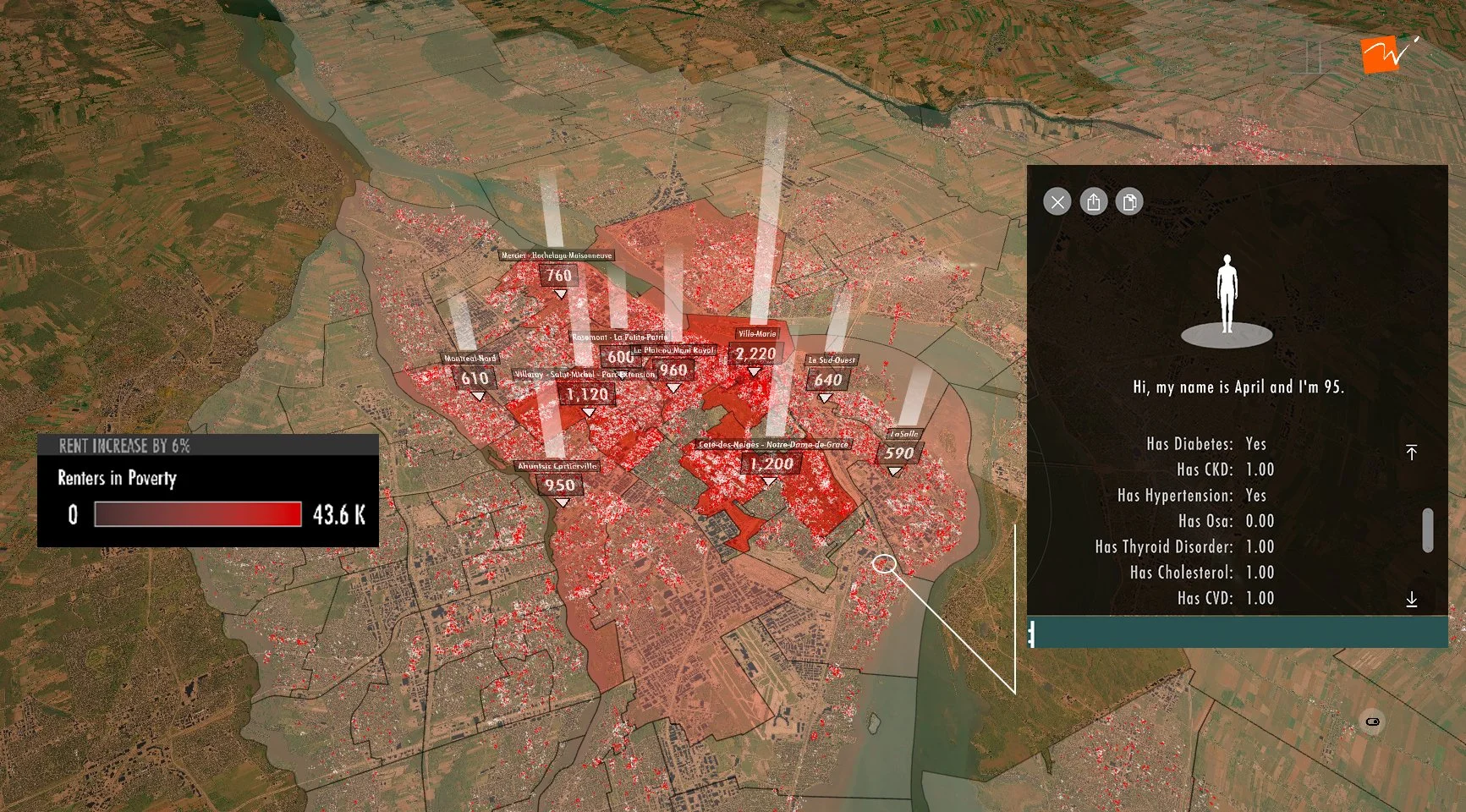
A 6% rent increase could thrust more than 30,000 people into financial insecurity, according to Centraide of Greater Montreal.
Montreal, Quebec (July 7, 2026) — A forecasting analytics study conducted by RUNWITHIT Synthetics for Centraide of Greater Montreal shows that a 6% rent increase could push more than 30,000 people into precarity—that’s almost 1.5 times the capacity of a sold-out Bell Centre. Of this number, more than 16,000 people would be put in a situation of extreme hardship, where the slightest unexpected expense could have severe consequences, including food insecurity, debt, housing loss and even homelessness.
These results draw in part on AI-powered models designed to simulate rental market dynamics in Greater Montreal and forecast the effects of rent increases. Using a digital replica of an area covering 66 municipalities, the study makes it possible to estimate the potential impacts of rising housing costs and highlight their real-world effects on households.
The hypothetical 6% increase is based on recent market trends. This scenario makes it possible to assess the impacts of a significant—yet plausible—increase, particularly for those whose financial flexibility is already stretched to the limit. For comparison, the increase recommended by the Tribunal administratif du logement was approximately 4% in 2024, 5.9% in 2025 and 3.1% in 2026. Over three years, this represents a cumulative hike of roughly 13.6%.
This rent burden study builds on the Together for Housing initiative launched in 2023 by Centraide of Greater Montreal. It responds to one of the solutions identified by the initiative, namely improving and sharing data to support more effective access to adequate housing for low-income households.
“Three years after Together for Housing was introduced, the situation is more urgent than ever. The demand for organizations’ services has surged (as shown by the Financial Anxiety Index data) and the impacts of housing costs are increasingly visible, with families being displaced, individuals pushed to the brink financially and workers unable to find a decent place to live,” said Tasha Lackman, President and Chief Executive Officer of Centraide of Greater Montreal.
“This data confirms that investing in social and community housing is vital to ensure people have access to options that are affordable and suited to their needs. It also prompts us to explore new avenues with partners across our ecosystem to improve housing conditions and preserve the existing rental housing stock. New initiatives such as rent subsidies and rent banks are already taking shape, offering concrete solutions to address this crisis.”
"RUNWITHIT Synthetics' INFLECTOR AI platform generated a never-identified, detailed and accurate synthetic population of Montreal, including income, expenses, households, and real residences, and then increased rent by 6%," said CTO and Co-Founder Dean Bittner.
"What emerges are the households, the people, their locations and circumstances, so that we can measure the return on investment and return on impact of the steps we can take—for whom and where—to stem a slide toward precarity and poverty, and prevent those social and financial repercussions. We achieved this without compromising any personal privacy or using any surveillance data."
Ten Boroughs Under Pressure
According to RUNWITHIT Synthetics projections, a 6% increase in rents would drive 10,000 residents across 10 Montreal boroughs into extreme precarity. These boroughs are Ahuntsic-Cartierville, Côte-des-Neiges–Notre-Dame-de-Grâce, LaSalle, Le Plateau-Mont-Royal, Le Sud-Ouest, Mercier–Hochelaga-Maisonneuve, Montréal-Nord, Rosemont–La Petite-Patrie, Ville-Marie and Villeray–Saint-Michel–Parc-Extension.
The most severe impacts are in Ville-Marie and Le Plateau-Mont-Royal, where the rate of extreme precarity reaches 43% and 34% respectively, making both areas particularly vulnerable to rent increases.
Precarity Index: A more comprehensive metric to support more effective action
Traditional financial vulnerability indicators generally focus on income, without factoring in the burden of household expenses. A precarity index has been developed to address this shortcoming, taking into account both income and essential expenses (housing, food, electricity). The index has four levels: stability, low precarity, high precarity and extreme precarity.
Extreme precarity is characterized by persistent instability. People experiencing extreme precarity have little or no money left after covering these essential expenses. As a result, they are often forced to make difficult choices, such as skipping meals, making late payments, turning down the heat or going without medical care.
The study is available to read, click here.
Une hausse de 6 % des loyers pourrait plonger plus de 30 000 personnes dans la précarité, selon Centraide du Grand Montréal.
Montréal, le 7 juillet 2026 − Une analyse prévisionnelle réalisée par RUNWITHIT Synthetics pour le compte de Centraide du Grand Montréal, révèle qu’une hausse de 6 % des loyers pourrait faire basculer plus de 30 000 personnes dans la précarité, soit près d'une fois et demie la capacité du Centre Bell. Parmi elles, plus de 16 000 se retrouveraient en situation de précarité extrême, où la moindre dépense imprévue pourrait entraîner des conséquences graves : insécurité alimentaire, endettement, perte de logement, voire itinérance.
Ces résultats reposent notamment sur des modèles développés à l’aide de l’intelligence artificielle, conçus pour simuler l’évolution du marché locatif dans le Grand Montréal et prévoir les effets de la hausse des loyers. En s’appuyant sur une réplique numérique du territoire couvrant 66 municipalités, l’analyse sur le poids du loyer permet d'estimer l’impact possible de l’augmentation des coûts du logement et de montrer concrètement comment cela affecte les populations.
L’hypothèse d’une hausse de 6 % repose sur les tendances récentes du marché. Elle permet de mesurer l’impact d’une augmentation significative, mais plausible, sur les ménages, surtout ceux dont la marge de manœuvre financière est déjà limitée. À titre de comparaison, la hausse recommandée par le Tribunal administratif du logement était d’environ 4 % en 2024, de 5,9 % en 2025, et de 3,1 % en 2026. Sur trois ans, cela représente une augmentation cumulative d’environ 13,6 % des loyers.
Cette analyse sur le poids du loyer s’inscrit dans la continuité de la mobilisation collective Agir ensemble pour le logement, lancée en 2023 par Centraide du Grand Montréal. Elle répond à l’une des pistes de solution identifiées, soit le renforcement et la diffusion des données permettant de favoriser l’accès à des logements adéquats pour les ménages à faible revenu.
« Trois ans après Agir ensemble pour le logement, l’urgence est encore plus criante. La demande pour les services des organismes a explosé (comme le démontrent les données de l’Indice d’anxiété financière), et ces derniers constatent chaque jour les impacts du coût du logement : familles déplacées, personnes seules à bout de ressources, travailleurs incapables de se loger dignement », mentionne Tasha Lackman, présidente et directrice générale de Centraide du Grand Montréal.
« Ces données confirment qu’investir dans le logement social et communautaire est essentiel pour permettre à la population de se loger adéquatement selon ses moyens. Elles nous amènent également à explorer de nouvelles avenues avec nos partenaires de l’écosystème afin d’améliorer les conditions de logement et d’assurer le maintien du parc locatif. De nouvelles initiatives émergent déjà, comme les subventions au loyer et les banques d’aide au loyer, qui offrent des pistes concrètes pour répondre à l’urgence. »
« La plateforme INFLECTOR AI de RUNWITHIT Synthetics a généré une population synthétique détaillée et précise de Montréal qui n’est jamais associée à des personnes identifiables et sans utiliser de données de surveillance. Cela comprend des données sur les revenus, les dépenses, les ménages et les résidences réelles, avant de simuler une augmentation des loyers de 6 % », déclare Dean Bittner, directeur de la technologie et cofondateur de RUNWITHIT Synthetics.
« Ce qui en ressort, ce sont les ménages, les personnes, leurs lieux de résidence et leur situation, nous permettant de mesurer le retour sur investissement ainsi que l'impact des mesures que nous pouvons prendre ─ pour qui et à quel endroit ─ et ce, afin de freiner le glissement vers la précarité et la pauvreté et d'éviter ces répercussions sociales et économiques. »
Dix arrondissements sous pression
Selon les projections de RUNWITHIT Synthetics, une hausse de 6 % des loyers entraînerait un basculement vers la précarité extrême pour 10 000 résidents répartis dans 10 arrondissements de l’île de Montréal : Ahuntsic-Cartierville, Côte-des-Neiges–Notre-Dame-de-Grâce, LaSalle, Le Plateau-Mont-Royal, Le Sud-Ouest, Mercier–Hochelaga-Maisonneuve, Montréal-Nord, Rosemont–La Petite-Patrie, Ville-Marie et Villeray–Saint-Michel–Parc-Extension.
Les situations les plus préoccupantes se retrouveraient dans Ville-Marie et sur Le Plateau-Mont-Royal, où les taux de précarité extrême atteindraient respectivement 43 % et de 34 %, rendant ces secteurs particulièrement vulnérables à une hausse des loyers.
L’indice de précarité : une mesure plus complète pour mieux intervenir
Les indicateurs traditionnels de vulnérabilité financière se concentrent généralement sur les revenus, en négligeant le poids des dépenses. Pour combler cette lacune, un indice de précarité a été développé. Il tient compte à la fois des revenus et des dépenses essentielles (logement, alimentation, énergie). Cet indice se décline en quatre niveaux : stabilité, faible précarité, forte précarité et précarité extrême.
La précarité extrême se caractérise par une instabilité constante. Après ces dépenses incontournables, il reste peu ou presque rien. Les personnes sont alors contraintes à faire des choix immédiats, comme se priver de repas, retarder des paiements, réduire le chauffage ou renoncer à des soins.
Pour consulter l’étude, cliquez ici.
About Centraide of Greater Montreal
A true agent of change, Centraide of Greater Montreal is a public foundation whose mission is to bring people together and take action for an inclusive and poverty-free Greater Montreal. To achieve this goal, it supports a network of 375 community agencies and projects in Laval, in Montreal and on the South Shore that improve the living conditions of people in a situation of poverty. Centraide works with the Greater Montreal population and with communities, businesses, institutions and philanthropic organizations. For more information or to contribute to Centraide’s campaign, go to centraide-mtl.org.
About RUNWITHIT Synthetics Inc.
Founded in 2014, RUNWITHIT Synthetics (RWI) is a women-led, Certified Indigenous Business headquartered in Edmonton, AB, Canada. RWI’s leading-edge technology and its applications have won numerous global awards, including the ASTech “Innovation of the Year” and the United Nations’ Global Call for Decarbonization. RWI is dedicated to advancing a better world by applying diverse expertise and voices through deep tech to inform equity, sustainability and resilience.
PRESS CONTACT:
For any media inquiries, please contact:
Melissa Fierro, Director of Marketing - melissa@runwithitsynthetics.com