
Generating Trusted Health Data with Synthetic Populations

Cardiovascular disease remains the leading cause of death worldwide, yet many people at risk remain invisible to healthcare systems until conditions become severe.
Health systems increasingly need tools that allow them to anticipate risk, test interventions, and design prevention strategies before real-world implementation.
RWI’s technology generates sophisticated, trusted health data about people, communities, and systems under changing conditions, creating an accessible, compelling format for sharing converged intelligence, providing increased clarity and empowering decision-making.
Our most recent project related to health and health attributes is PHRESH: Patient Health Response in Emergent and Secure Habitats for Connected Healthcare.
PHRESH is an international consortium research project under the ITEA4 Eureka Cluster, comprising 24 partners across seven countries. RWI’s role is to synthesize cardiovascular disease risk and comorbidities to support the evaluation and adoption of connected-care technologies such as wearable monitoring and remote patient management systems.
We’re understanding health risks, planning services, and designing prevention strategies, all without using real patient data. By creating a digital version of a city’s population, RWI can explore how disease risk develops, where vulnerable groups are located, and how care strategies can be improved before problems escalate.
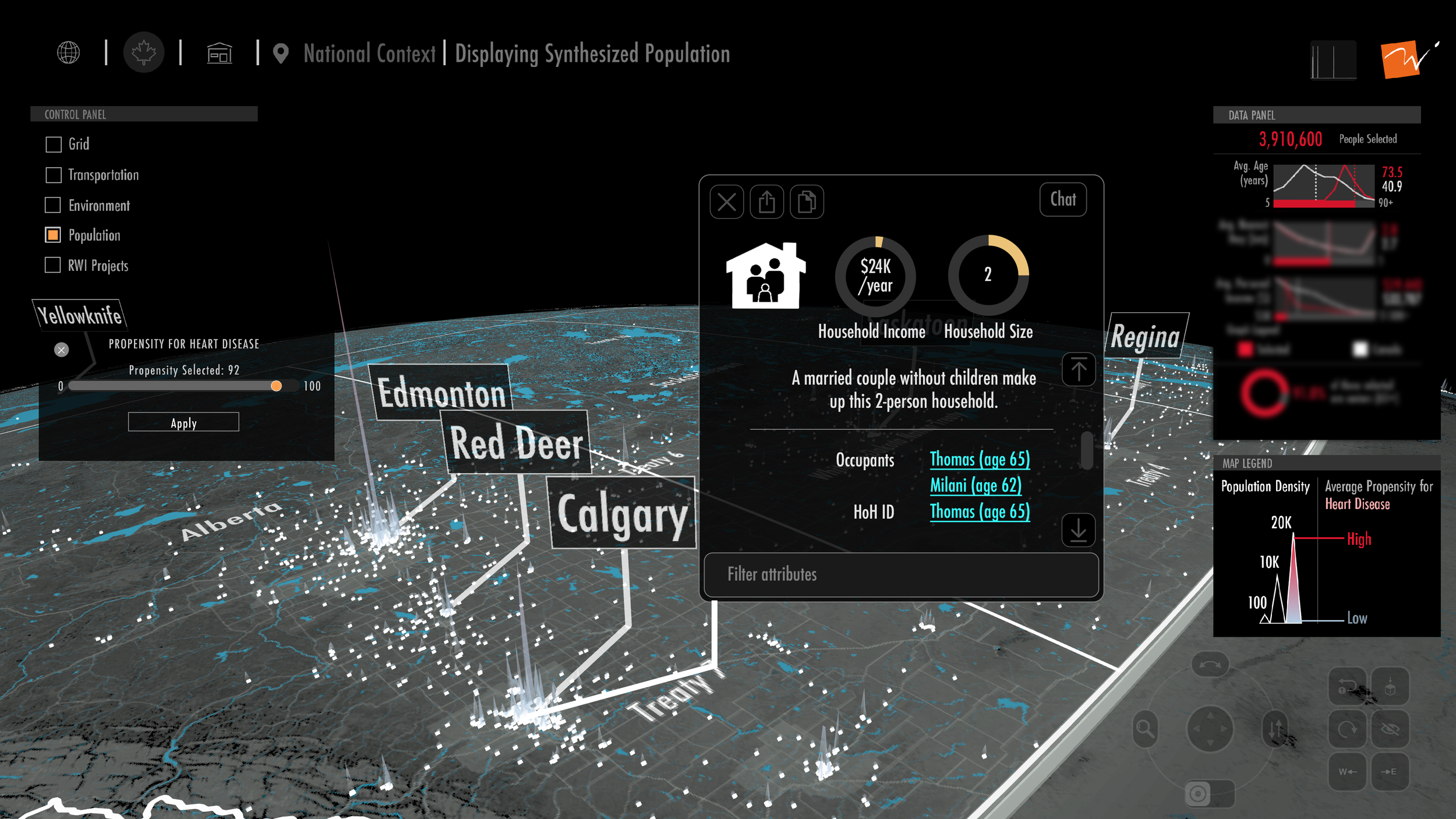
What Are Synthetic Populations?
People are one of the most significant factors to consider when assessing future challenges, risks, and investments in health and medicine. They are also the most complex.
People are unique, unpredictable, and difficult to model with traditional approaches. By combining diverse aggregated data sources with advanced agentic techniques such as integrated population models and agent-based modelling, RWI addresses this complexity by bringing rich, simulated environments to life.
Moreover, Synthetic Populations are generated without relying on privacy-protected information or historical data that is missing, irrelevant, or inaccurate. Representative, never-identified Synthetic Populations demonstrate intersectional impacts and protect privacy.
Building Simulation Scenarios
To test connected-care scenarios as part of PHRESH, we first generated never-identified synthetic populations for the Montreal region, with each individual assigned a CVD risk score that identifies both prevalent CVD cases and high-risk individuals who are not yet diagnosed.
The synthetic population incorporated demographics, socioeconomic status, lifestyle and behavioural factors, environmental attributes, and comorbidities, including hypertension, diabetes, dyslipidemia, obesity, chronic kidney disease, chronic obstructive pulmonary disease, obstructive sleep apnea, thyroid disorders, and asthma.
The modelled CVD risk score captures subclinical high-risk individuals through integrated risk-factor weighting, enabling prevention-focused interventions to control health conditions that affect CVD and modify behaviours.
Hypertension is one of the most prevalent conditions affecting CVD risk scores and was selected as the first health condition to synthesize due to its strong relationship with cardiovascular outcomes and responsiveness to monitoring interventions.
We also developed four distinct scenarios related to CVD risk scores and interventions:
Current condition stratified by hypertension severity, either mild, moderate, or severe.
Natural disease progression over three to five years without treatment
Progression with wearable technology, remote monitoring interventions, or both, located at home. This scenario included blood pressure monitoring with remote clinician oversight via digital platforms.
And finally, a traditional treatment schedule, as delivered through clinic-based physician visits.
Each scenario pathway maps progression toward an ideal treatment benchmark — adherence and optimal response — with group-specific improvement strategies tailored by patient attributes.
This capability enables researchers and health systems to identify hidden high-risk populations before disease becomes visible, test digital health technologies before real-world deployment, evaluate prevention strategies at population scale, and plan healthcare resources and interventions more effectively.
Unlocking Deeper Insights

Health systems worldwide are facing growing pressure from aging populations, rising chronic diseases, and limited clinical resources. Tools that enable earlier intervention, better targeting of care, and evaluation of digital health technologies are becoming essential.
RWI is unlocking deeper insights into cardiovascular health, informing the adoption of connected care, and activating better health outcomes for systems, providers, and patients.
RWI's synthetic population platform enables researchers, healthcare systems, and policymakers to explore disease risk, test connected-care technologies, and evaluate interventions before real-world deployment. By combining population modelling, health intelligence, and simulation, we are helping health systems design more proactive and resilient approaches to care.
Contact us today to see the health outcomes, disease conditions, or intervention simulations facing your organization or community.